Nigeria's WOFBEC 2026: Thy Kingdom Come.
- Faith Njoku
- 2 days ago
- 6 min read
The women were wailing.
The men were chanting.
The children were jumping.
The atmosphere was powered not by the brisk unreliability of Nigerian electricity, but by a divine grid of charged airwaves. Sweat beads hugged the temple of the lead pastor as the dialectical serenade of Christian tongues pierced the chambers of the auditorium. Power.
The voices in prayer, all speaking in unknown tongues, carried the thousands standing in the suspense, filled with anticipation of the early Tuesday morning. Jonathan's heart was racing, revving, pounding. His mind was carried by the acoustic rhythm of the prayers.
His senses heightened as he attempted to swallow the ball of emotion forming at the base of his throat. Emotions, still undiscerned, began to rise.
He looked around. No one appeared to take heed of his visible dis-cohesion. He peered across the hall. Eyes tightly shut, men towering over two meters clapped their hands furiously in prayer. Their bodies moved in uniform sway and vibration. Swallowing his remaining hesitation, he gave himself to the divine presence.
He closed his eyes, lifted his head, raised his arms, and began to sway methodically from right to left, reciting The Lord’s Prayer. He released the prayer repetitively, quickening his pace, quickening his flow. Before he realized it, his hands matched the beating of his heart. Clapping in silent cue, he continued reciting the scripture, faster and faster.
Louder.
Yes, he could hear his voice above the wailing.
He recalled the jagged stones of his vicarious youth. The years of barren fields. The years of running alongside his brothers. An oath to protect. A strong heart for his country and her allies. He recalled the lives claimed. The brothers he would never see again. Their smiles etched into memory.
Tears welled.
Lord, let Thy Kingdom come. Let Thy Kingdom come.
He began to weep. In trust. In safety. In remembrance. He allowed the gentleness of the Lord’s presence to take over and gave himself fully to prayer. The words leapt and heaped, climbing over one another, sounding slightly incoherent yet deeply sincere. Faster. Repeating the scripture.
A single tear rolled down his cheek.
Then he released a long yell.
A breath of fire.
A breath of power.
A breath of strength.
____________________________________________________________________________________________________
WOFBEC stands for the World Faith Believers Convention. It is an annual Christian faith-based prayer conference with a resounding focus on worship, teaching, intercession, prophetic ministry, and spiritual impartation.
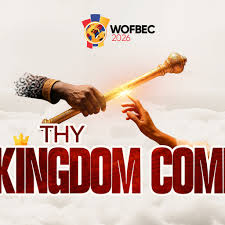
It consists of 9 consecutive days, often exceeding 12 hours daily, filled with praise, worship, teaching, and spiritual impartation.
It brings together a global roster of influential ministers and speakers, including revered veteran African pastors and international voices, under a central theme designed to deepen the believer’s spiritual engagement.
WOFBEC is arguably representative of a central headquarter for unity in Christian teaching and engagement. It is reflected in the strategic organizational framework and participation of the nation’s spiritual leadership. Tens of thousands attend physically, both domestically and internationally, while millions engage globally through online viewership.

To understand the weight of WOFBEC’s significance, it is necessary to revisit the foundational and organizational infrastructures that have historically guided African strategy and decorum. Many of these systems were framed, constructed, and engineered during post-colonial and post war eras. Wars destroy territories, but they also create geographic liabilities, spaces ripe for political and economic exploitation through strategic supply chains.
Amid these systems, a critical component remained neglected in early reconstruction. The revival of the unity spirit of Africa’s deeply diverse people.
During British colonial rule, leadership engineered tribal divisions which actively promoted policy and geographic manipulation. In 1914, Governor Lord Lugard merged Nigeria’s Northern and Southern Protectorates into a single colony not for unity, but for administrative control and strategic intervention.

Over 250 ethnic groups, each with distinct cultures, languages, and socio-political dispositions, were subjected to an indirect rule system that preserved traditional hierarchies (kingdoms) while subordinating them to colonial authority.
The shock of forced integration remained largely unaddressed. The justified ethnic and territorial differences continued to send aftershocks through generations who continued learning- by sheer survival- how to assimilate.
To juxtapose this historical trajectory with a proud organizational development, one must examine the rise of ECOWAS, the Economic Community of West African States.

ECOWAS stands as one of the most substantial regional organizations on the African continent, not only economically, but politically and militarily. Its influence rests on African ownership, collective sovereignty, and enforceable regional norms. It was founded in 1975 under the Treaty of Lagos by fifteen West African states.

Its vision emerged from African leaders who understood that fragmented post-colonial states were economically and strategically weak in isolation. External actors later became donors and partners, not architects.
ECOWAS has substantial benefits, it allows for free movement of people through the ECOWAS passport, trade liberalization, regional infrastructure coordination, security cooperation, public health monitoring, and ongoing conversations toward a single regional currency.
Its growth stands in clear contrast to earlier foreign intervention frameworks and reflects the strength behind the cause that formed this African led partnership.

Among the notable Nigerian leaders represented was Pastor Jerry Eze, an internationally recognized pastor and global faith leader. Jerry Eze is the revered senior Pastor of Streams of Joy International, NSPPD. In 2025 alone, Pastor Jerry Eze emerged as one of the most highly viewed preachers on YouTube worldwide, ranking third overall across the platform with 102 million clocked viewing hours, surpassed only within the gaming category. He is widely acclaimed for his expansive global reach and influence, with a leadership base that regularly hosts ECOWAS leadership, African presidents, senior state diplomats, and key African secretariat stakeholders. His ministry reflects the growing intersection of faith, leadership, and global engagement emanating from Nigeria.
Webster defines cause as that which produces an effect or consequence, and as a principle served with dedication and zeal. A cause can animate a nation or drive it into conflict. The distinction lies in whether a people accept a just cause anchored in moral determinism rather than moral relativism.
______________________________________________________________________________________________________________
It is here that the significance of WOFBEC becomes unmistakable.

The reputation of its speakers’, leaders from across Nigeria and Africa, reveals its role in building, supporting, realigning, and reforming continental systems.
The 2026 theme Thy Kingdom Come was carried through the biblically symbolic Four Faces, the Lion, the Ox, the Eagle, and the Man.
Each spoke to dimensions of African systems: authority, service, vision, and humanity; challenging, reforming, and refining them.
There is an unmistakable focus emerging across Nigeria. What was once perceived as vulnerability has become a cornerstone of national engagement. Members of the African Union Peace and Security Council were in attendance. Diplomats and dignitaries observed with diligence and expectancy.
This matters.

As global powers are threatened by cartel motivated politics, a corrupted and coercive media, and economic disenfranchisement, Nigeria continues to flourish amid very high-pressure. As the body of Christ becomes increasingly aware of its mandate, conflict prevention and resolution are increasingly sustained by leaders shaped by a Kingdom first consciousness.
On the horizon, a shift is evident.
The United States, while remaining within the United Nations, has reduced and politicized engagement across several UN mechanisms. Perceived inefficiencies, ideological misalignment away from US priorities, and constraints on strategic autonomy have created a legitimacy vacuum in conflict prevention and norm setting, particularly in Africa. As UN missions become more risk averse, peace operations increasingly lean on regional actors.
This creates space.
The African Union Peace and Security Council, alongside Nigerian leadership and ECOWAS, is structurally positioned to fill this gap through African led legitimacy and regional proximity. As the United States advances its America First global health and security posture, it may increasingly rely on morally aligned African partners to uphold regional stability.
______________________________________________________________________________________________________________
Security institutions do not fail first due to lack of arms, but because of moral incoherence, elite capture, corruption, and loss of public trust.

WOFBEC emphasizes personal responsibility, stewardship, integrity, long term vision, and nation building theology with the singular aim of forming leaders who can wield power without destroying institutions.
WOFBEC functions beyond politics.
It is a geopolitical rarity safeguarded by spiritual leadership.
It is a transnational values formation and conscience shaping retreat attended by policymakers, military leaders, technocrats, influencers, business owners, parents, educators, legislators, and law enforcement partners.

As African leadership continues to promote WOFBEC, a clear driver is emerging across the Nigerian nation to establish a methodical and credible framework for rising pastors, preachers, bishops, evangelists, apostles, and ministers. WOFBEC, in its ongoing transition and maturation, carries the potential to become a structured gateway for ministerial development rather than a singular annual gathering.
The prospect of visiting clergy receiving continuing education credit for attendance directly advances the vision of a national institute proposed by Apostle Joshua Selman. This vision emphasizes cohesion in teaching frameworks, doctrinal alignment, leadership integrity, and consistent messaging to an ever-growing Nigerian population.
Such an institute would not dilute spiritual authority, but rather strengthen it through structure, accountability, and intentional formation.

The digitization of attendance and accreditation could support a robust instructional architecture that includes Administration of Instruction Programs, focusing on strategies for implementation, maintenance, and evaluation of curriculum. Seminar tracks in Educational Leadership could provide foundational understanding of leadership structures and decision-making processes within educational and ecclesiastical organizations.

Additional modules addressing Issues and Skills for Counseling Students would introduce structured interpersonal practices required for guiding young adults and emerging leaders. Educational Facilities planning would further support the mission by emphasizing the appraisal, management, and strategic development of buildings, sites, equipment, and support services necessary for sustainable growth.
This evolution positions WOFBEC not only as a spiritual convening, but as a catalytic institution for leadership formation, national coherence, and generational continuity.


Comments